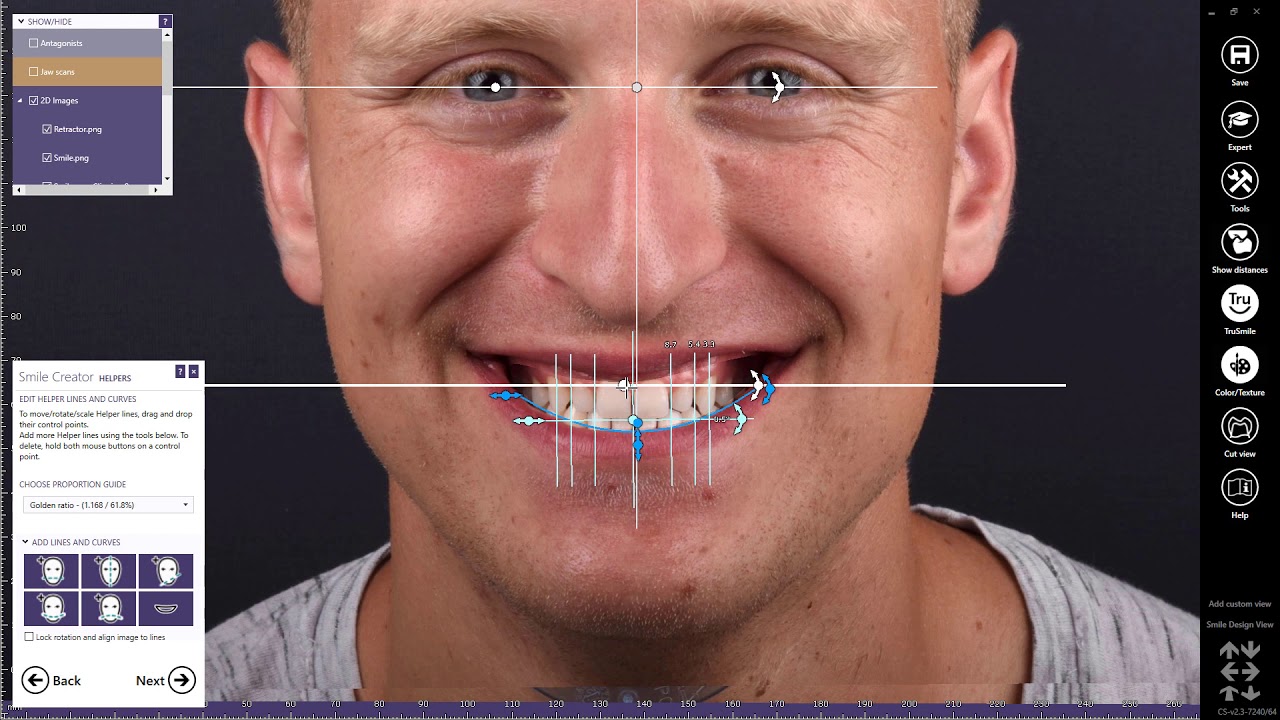
exocad — Designing the Visual Language of Dental CAD/CAM

Product Design · UX/UI · Dental CAD/CAM · 3D Workflows · Design Systems

I joined exocad as its first designer, working directly with the CEO to establish the visual language, icon systems, and core design foundations of its industry-defining dental CAD/CAM software.

Over nearly eight years, my role evolved from visual and interface design into comprehensive product design—shaping how complex 3D modeling, clinical dental restoration, and professional CAD workflows could become intuitive, precise, and friction-free.

Designing for Complexity

Dental CAD brings together 3D geometry, specialist clinical tools, sub-millimeter precision, and highly technical workflows.

The challenge wasn’t simply to make the interface look modern. It was to architect a cohesive visual and interaction language that made sophisticated engineering tools immediately understandable without compromising the exacting standards of professional dental technicians.

My core focus was driving interface consistency while making complex operations faster to recognize, learn, and execute.

Designing clean, high-performance interfaces for complex 3D dental CAD workflows.

Building a Scalable Visual Vocabulary

Professional CAD applications demand a robust visual system that users can learn quickly and rely on daily under high-stress clinical environments.

I designed and organized an exhaustive icon system spanning dental treatments, modeling operations, CAD/CAM workflows, application functions, and interface actions.

Rather than a collection of isolated graphics, the system was built as a scalable visual vocabulary featuring optimized variants across different interface contexts and display sizes.

The visual architecture covered everything from crowns, bridges, pontics, and abutments to advanced scanning, alignment, correction, and implant planning.

The exocad icon system — a structured visual vocabulary built for professional dental CAD applications.

Dental Treatment Vocabulary

Dental CAD requires users to interact with a vast lexicon of specialized clinical objects and multi-stage treatments.

I translated these complex medical concepts into instantly recognizable visual forms while maintaining strict stylistic and structural consistency.

The objective was to reduce cognitive load, making dense clinical terminology visually intuitive within fast-paced lab workflows.

Structured visual vocabulary for dental restorations and clinical objects.

CAD/CAM Workflow Vocabulary

Beyond static dental elements, the interface had to communicate active actions and operations—scanning, free-form modeling, alignment, editing, transformation, and mesh manipulation.

The icon system extended seamlessly across every phase of the software pipeline, giving users a dependable mental model for tool behaviors.

Standardized icons for modeling, scanning, alignment, and editing operations.

Deconstructing Complex Dental Tools

True icon design in professional software isn’t about redrawing shapes—it’s about distilling the core mental model of an operation.

By breaking down complex tools into fundamental visual elements—geometry, selection mechanics, transformations, materials, directions, and states—I established a predictable design system that scaled effortlessly.

This rigorous mapping covered advanced tools including Add Post, Blockout Selection, Clone, Emboss, Filler, Smooth Area, Add/Remove Wax, Mask, Measure, Trim Mesh, Finishline, and Mesh Connector.

Proof-of-concept explorations simplifying advanced dental-CAD tools into distinct, readable forms.

This methodology shifted the product from a collection of ad-hoc features to a systematic, unified professional environment.

Jaw Motion & 3D Spatial Workflows

Certain modules required communicating dynamic, multi-axis movement—translating complex biomechanical relationships in three-dimensional space into clear visual cues.

Iconography engineered for 3D spatial mechanics and jaw-motion simulation.

Icons in Context: Full Denture Workflow

A design system proves its value when deployed where it matters: inside the live product.

This custom iconography was integrated directly into heavy, precision-critical environments like the full denture-design module, enabling fluid navigation across 3D workspaces, parameters, and multi-step wizards.

Custom iconography supporting complex full-denture design workflows in production.

Designing for Dynamic Interaction

Visual systems become truly powerful when they communicate not just what a tool is, but what the tool is actively doing.

For complex calculations, I leveraged real-time visual feedback and state changes to clarify relationships between geometry, numerical parameters, and resulting transformations.

From Visual Design to Product Architecture

Over nearly eight years, my scope expanded organically from pure visual styling into UX architecture, interaction models, and end-to-end product thinking.

My work bridged atomic micro-interactions with macro user journeys—ensuring that information hierarchy, layouts, and system logic scaled together.

3D Modelling · Dental Restoration · Interface Systems · Interaction Design · Iconography · CAD/CAM Workflows

The Foundation: Delcam & Professional CAD

My specialization in high-stakes CAD/CAM actually began prior to exocad.

At Delcam, I worked on heavy engineering and dental packages including DentCAD, PowerSHAPE, and PowerMILL, designing systems for technically demanding enterprise users.

This background provided a deep appreciation for the realities of professional operators—reinforcing my lifelong design philosophy: respect the underlying complexity, but eradicate friction from the user experience.

The Broader Impact

The foundational systems built at exocad and Delcam shaped my subsequent trajectory across healthcare tech, enterprise SaaS, complex data systems, and AI-driven platforms.

Though domains change, the core design mandate remains identical:

  • Decode complex systems.
  • Uncover clean architectural structures.
  • Translate complexity into intuitive, human-centric software.

The Work Continues

Whether designing dental platforms, industrial tools, or next-generation AI software, my focus remains razor-sharp: making deeply sophisticated technology feel effortless.